Guide
How to Read a Compass: Directions, Degrees and Bearings
Identify the north needle, read the number at the index line and turn that bearing into a direction. Includes a labeled diagram and practice examples.
Updated October 25, 2026
Published by Online Compass · Accuracy and testing
To read a compass, point its direction-of-travel arrow where you want to measure, align the dial’s north reference with the north-seeking needle, and read the degrees at the index line. That number is your magnetic bearing. On a phone compass, point the top edge of the phone toward the subject and read the displayed heading instead.
This guide explains what the parts and numbers mean. For following a route or setting a map bearing, use how to use a compass.
Know which part you are reading
A common hiking compass has a clear baseplate and a rotating circular housing. These instructions apply to that design; lensatic, marine and digital compasses can present the reading differently.
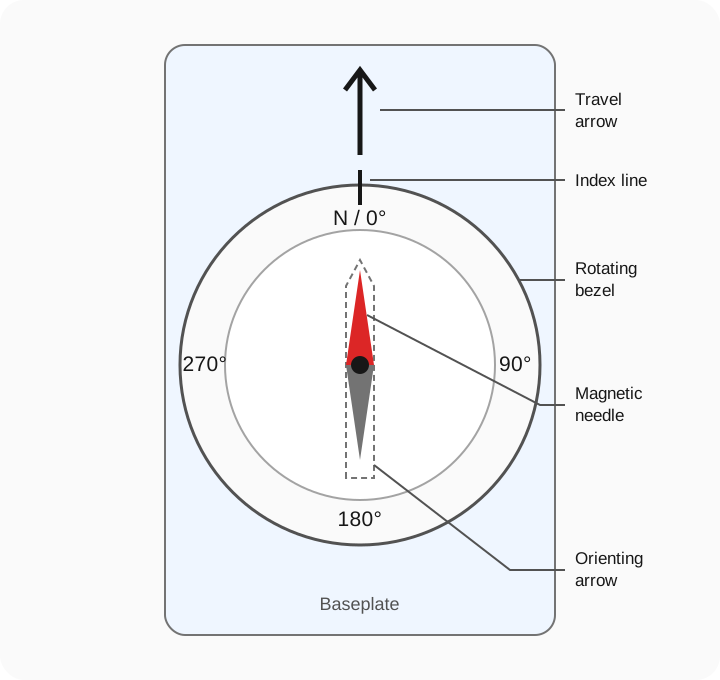
| Part | What it tells you |
|---|---|
| North-seeking needle | The local magnetic north reference; often the red or marked end |
| Rotating bezel | The circular scale you turn to set or measure a bearing |
| Orienting arrow | The printed arrow inside the housing that you align with the north-seeking needle |
| Direction-of-travel arrow | The direction the baseplate points, which can be different from north |
| Index line | The fixed mark at which you read the bezel’s degrees |
Do not confuse the moving magnetic needle with the direction-of-travel arrow printed on the baseplate. The needle establishes north; the travel arrow indicates the direction you are measuring.
Read a physical compass in five steps
- Hold it level. Keep the baseplate roughly horizontal so the needle can move freely.
- Move away from interference. Keep phones, magnetic clasps, speakers, vehicles and steel objects away from the compass.
- Point the travel arrow at your subject. For example, aim it toward a tree across an open field.
- Rotate only the bezel. Keep the baseplate aimed at the tree while turning the housing until the orienting arrow lines up with the north-seeking end of the needle. Match north to north, not north to the south end.
- Read the index line. The number beside the travel arrow is the magnetic bearing from your position to the tree.
If your compass has an adjustable declination correction, check its setting first. A previously adjusted compass may not be reporting an uncorrected magnetic bearing. Follow that model’s instructions.
Turn degrees into a direction
Bearings run clockwise from north. North can be written as 0° or 360°; these are the same direction.
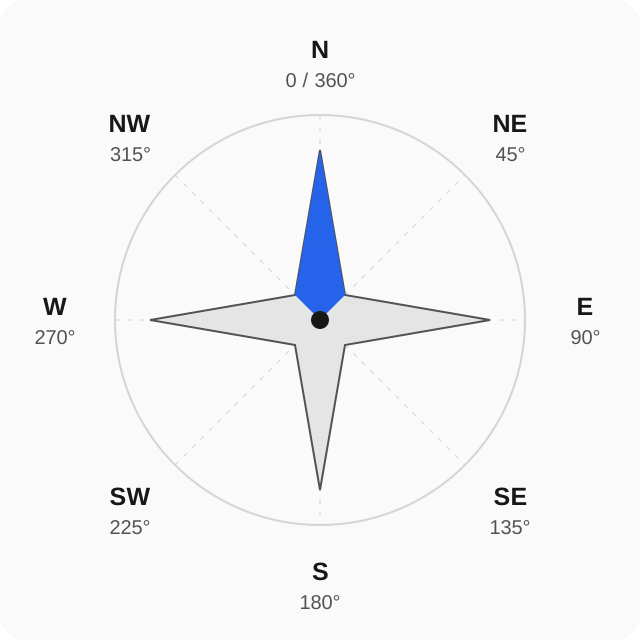
| Reading | Meaning |
|---|---|
| 045° | Northeast |
| 090° | East |
| 135° | Southeast |
| 180° | South |
| 225° | Southwest |
| 270° | West |
| 315° | Northwest |
A three-digit bearing such as 045° is just 45° with a leading zero. A reading such as 100° lies 10° clockwise beyond east, toward the south. It is not a distance.
The compass directions and degrees tables include all sixteen named compass points.
Worked example: reading a tree’s bearing
Suppose your travel arrow points at a tree. You turn the bezel until its orienting arrow matches the north-seeking needle, then read 120° at the index.
The tree lies 30° south of east from where you stand: east is 90°, and 120° is another 30° clockwise. The needle still points north. It does not point at the tree unless the tree happens to be north of you.
If you move to another place, the bearing to that same tree can change. A bearing belongs to a particular starting position and reference direction.
How to read a compass on your phone
Open the online compass, tap Start compass and allow sensor access when requested. On a compatible device, hold the phone flat and point its top edge where you want to measure.
Read the large degree value together with the direction label. For example, 270° / W means that the phone’s top edge points west. Do not assume that the top of a rotating compass graphic is always north.
Check whether the tool indicates magnetic north or true north. True north is geographic north; magnetic north follows the local magnetic field. The difference is magnetic declination, which depends on location and date.
If the page shows Manual exploration, moving the dial is only a demonstration. It is not a measured heading. See accuracy and device testing for sensor limitations.
Avoid these reading mistakes
- Reading the needle tip as your heading. On a baseplate compass, the heading is read at the index line after alignment.
- Aligning with the wrong needle end. This can reverse your result by 180°.
- Guessing the smallest tick value. Scales differ. Count the gaps between labeled degrees to find the value of one interval.
- Mixing north references. A magnetic bearing and a true bearing are not interchangeable without the appropriate correction.
- Treating a precise number as precise accuracy. A display can show single degrees even when the underlying measurement is less reliable.
References
- National Geographic: Compass explains magnetic needles, compass cards and adaptations.
- Britannica: Magnetic compass describes the magnetic reference and local deviation.
Frequently asked questions
Do I read the compass needle or the travel arrow?
The marked north end of the needle establishes magnetic north. On a baseplate compass, read your heading at the index line beside the direction-of-travel arrow after aligning the orienting arrow with the north end of the needle.
What does a compass reading of 225 degrees mean?
A bearing of 225 degrees means southwest, halfway between south at 180 degrees and west at 270 degrees.
Does the red compass needle point the way I should walk?
Usually the marked or red end points toward magnetic north, not your destination. Follow the direction-of-travel arrow after setting and aligning the compass. Check the manufacturer's markings because designs vary.